Ocean threat brief - June 18, 2026Ocean threat brief - June 18, 2026
Pacific marine heatwave threatens coral reefs and fisheries across equatorial zone — June 2026
On June 11, 2026, NOAA upgraded its alert status to an El Niño Advisory, confirming that El Niño conditions are no longer forecast but present across the central to eastern equatorial Pacific. With a 63% probability of a very strong event between November 2026 and January 2027, this marine heatwave is already driving extreme sea surface temperatures and widespread coral bleaching across thousands of miles of tropical ocean — potentially ranking among the strongest El Niño events on record since 1950.
The marine heatwave spans nearly the entire equatorial Pacific from 0° to 15°N, extending approximately 6,000 miles (10,000 km) westward from the coast of Ecuador. As of the June 13, 2026 Mercator Ocean International bulletin, the heatwave is stable in area but increasing in intensity, reaching severe to extreme levels in the equatorial axis. Additional severe heatwaves have developed in the North Pacific near 180°W and 50°N, the Sea of Japan, and the Yellow Sea, while a moderate-to-severe heatwave intensifies south of Sicily and Greece in the Mediterranean.
French Polynesia's Tuamotu Archipelago, including Fakarava, is experiencing bleaching conditions. The Pacific Islands region, from the Coral Triangle to the South Pacific, lies directly in the thermal stress zone.
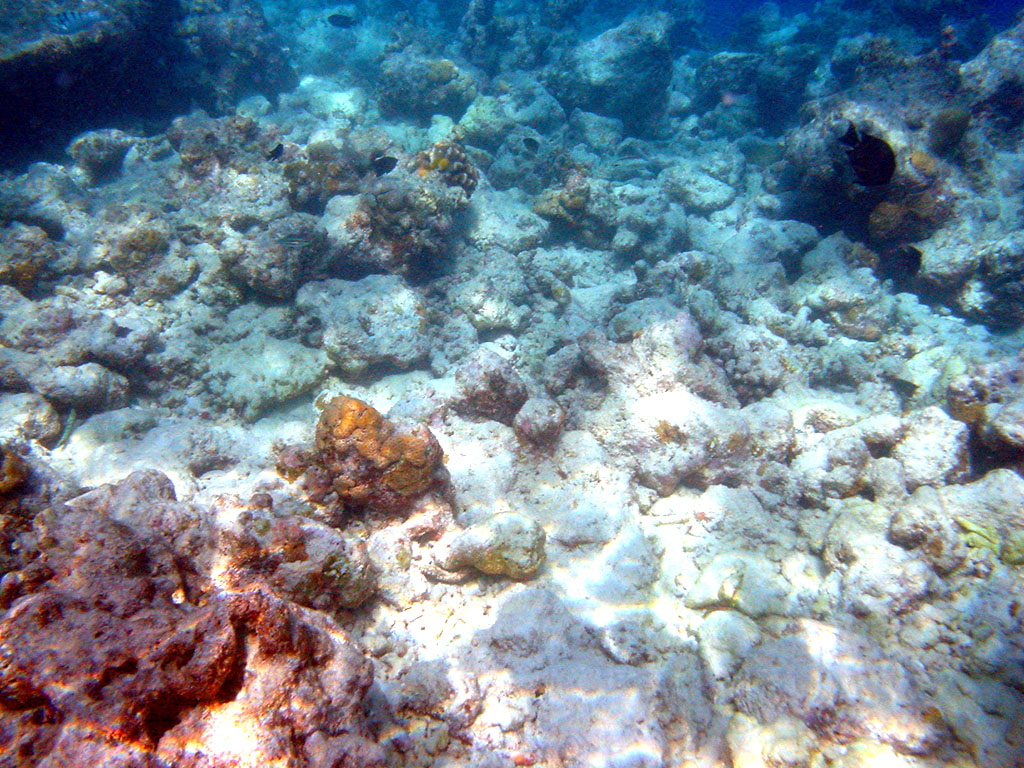 Photo : Bruno de Giusti / Wikimedia Commons — CC BY-SA 2.5 it
June 11, 2026 — NOAA's Climate Prediction Center issued an El Niño Advisory, confirming El Niño conditions are present with above-average sea surface temperatures across the central to eastern equatorial Pacific and crucially, atmospheric coupling with ocean warming. Source : ABC News, NOAA
June 13, 2026 — Mercator Ocean International marine heatwave bulletin reports the equatorial Pacific heatwave "remains stable in area but is increasing in intensity, reaching severe to extreme levels in some areas." Global marine heatwave coverage stands at 27% in Q2 2026. Source : Mercator Ocean International
63% probability — NOAA forecasts a 63% chance of a very strong El Niño during November 2026 to January 2027, which would rank among the largest on record since 1950. Source : ABC News, NOAA
2 to 4°F (1 to 2°C) — Typical El Niño temperature anomalies across the equatorial Pacific. In 2026, some zones are already approaching or exceeding these thresholds. Source : The Conversation
40–45% global coverage — Marine heatwave aerial coverage is forecast to reach 40–45% by late Q3 2026 due to El Niño, compared to 27% in Q2. Source : Climate Impact Company via Perplexity
May 25, 2026 — Peer-reviewed research published in Coral Reefs (Springer Nature) documented the impact of the 2024 coral bleaching event on a remote atoll in the Tuamotu Archipelago, French Polynesia, establishing baseline mortality data ahead of the 2026 event. [Source : Springer Link](https://link.springer.com/article/10.1007/s00338-026-[code postal]-y)
 Photo : [personne] / Wikimedia Commons — CC BY 4.0
Coral reefs — Widespread bleaching is occurring across the Pacific. During the 2016 El Niño, reefs in French Polynesia (Tahiti and Moorea) experienced 50–60% bleaching, with approximately half of bleached corals dying. The 2026 event is forecast to be stronger. Cumulative heat stress from prolonged exposure to above-average temperatures increases mortality risk, particularly for sensitive coral species. Source : NOAA Coral Reef Watch, ABC Australia
Commercial fish species — El Niño disrupts marine food webs by reducing upwelling of cold, nutrient-rich water, which decreases phytoplankton productivity. This "bottom-up" cascade reduces fish recruitment and alters migration patterns and geographic ranges. Species affected include :
Source : NOAA Fisheries, Scripps Institution of Oceanography, Marine Conservation Society
Marine mammals and seabirds — Reduced prey availability impacts sea lions, seals, dolphins, and seabirds. The 2014–2016 heatwave caused mass strandings of California sea lions due to starvation. Source : Phys.org
Pacific island communities — Subsistence and commercial fisheries dependent on reef ecosystems and pelagic fish face catch declines and food security risks. Coastal economies reliant on tourism to healthy reefs face economic impacts from bleaching mortality.
Worsening. NOAA forecasts El Niño to strengthen through Northern Hemisphere winter 2026–27, with peak thermal stress expected during November 2026 to January 2027. Marine heatwave coverage is projected to increase from 27% (Q2 2026) to 40–45% (late Q3 2026), driven by continued El Niño development.
June 12, 2026 — The Conversation reported forecast models give a 2-in-3 chance of a strong-to-very strong El Niño affecting weather, climate, and ocean temperatures across the planet by late fall 2026. Source : The Conversation
The Marine Conservation Society (June 8, 2026) notes that while El Niño has always been part of Earth's natural climate rhythm, "what appears to be shifting is its frequency and intensity. As global temperatures rise, these events are believed to be strengthening, increasing the risk of broader impacts." Source : Marine Conservation Society
Bleaching is not yet universal. Mercator Ocean International reports the heatwave intensity is increasing regionally ; local ocean currents, upwelling zones, and reef depth provide some resilience, but time is running out for sensitive ecosystems as summer progresses.
NOAA Coral Reef Watch — Issued updated thermal stress forecasts and bleaching alerts on June 11, 2026, providing real-time satellite monitoring to guide response efforts across Pacific reef systems. Source : NOAA
Marine Conservation Society (UK) — Published a comprehensive explainer on June 8, 2026, translating El Niño science for public audiences and highlighting the "catastrophic" impacts on marine food webs, from phytoplankton to apex predators. Source : Marine Conservation Society
International Fund for Animal Welfare (IFAW) — Released a press statement warning of "catastrophic impacts" on wildlife and coastal communities from the emerging Super El Niño, calling for coordinated conservation response across Pacific nations. Source : IFAW
Météo France Polynésie — Climatologist [personne] confirmed in April 2026 that atmospheric coupling with ocean warming is the "real test" of whether El Niño is genuine, providing critical early warning for French Polynesia's reefs. Source : Wanderin Paradise
Scripps Institution of Oceanography — Conducting ongoing research into marine heatwave impacts on fish reproduction, geographic ranges, and migration patterns, informing fisheries management decisions across the California Current and broader Pacific. Source : Scripps
Mercator Ocean International (Copernicus Marine Service) — Publishing weekly marine heatwave bulletins tracking spatial extent, intensity, and forecast evolution, providing the quantitative data underpinning emergency response planning. Source : Mercator Ocean International
https://link.springer.com/article/10.1007/s00338-026-[code postal]-y
INDEX : threat=Pacific marine heatwave / El Niño coral bleaching | zone=Equatorial Pacific, French Polynesia, Pacific Islands | severity=critical | trend=worsening