Ocean threat brief - June 11, 2026Ocean threat brief - June 11, 2026
IUU Fishing in the North Pacific and West African Waters – June 2026
Canada and Malaysia have launched major high-seas enforcement operations while China's distant-water fleet continues plundering West African fish stocks, exposing the scale and persistence of illegal fishing despite a decade of international treaty efforts.
Two critical zones are seeing enforcement intensification in June 2026:
North Pacific high seas – Canada's Operation North Pacific Guard is patrolling over 15,000 km of international waters, focusing on illegal driftnet use and compliance violations. The patrol zone covers the North Pacific Ocean between North American and Asian coasts, with aerial surveillance operating from Hokkaido, Japan.
West African waters – Chinese distant-water vessels are concentrated between Senegal and Mauritania. Malaysia's territorial waters in Southeast Asia are also under heightened surveillance through Operation Naga, targeting foreign vessel encroachment.
 Photo : Indonesian Ministry of Transportation / Wikimedia Commons — Public domain
Canada launched Operation North Pacific Guard on June 9, 2026 – its fourth annual IUU patrol. The Canadian Coast Guard vessel CCGS Sir Wilfrid Laurier will patrol for two months with 19 Fisheries and Oceans Canada officers conducting high-seas boardings and inspections. A long-range surveillance aircraft is running daily aerial patrols from Japan. Canada DFO, June 9, 2026
Malaysia's Operation Naga recorded 639 arrests and seizures exceeding RM244 million (US$52 million) from 2019 through March 2026. The operation seized 628 foreign fishing vessels and arrested 5,329 foreign crew members. Enforcement has intensified: arrests rose from 416 by August 2021 to 639 by March 2026, while financial seizures jumped from RM141.8 million (end-2024) to over RM244 million (March 2026). BERNAMA, June 5, 2026
IUU fishing costs the global economy US$23.5–36.4 billion annually and accounts for roughly 20% of the world catch – one in five fish taken worldwide. The UN Food and Agriculture Organization estimates 11–26 million tonnes of fish are lost each year. Pew Charitable Trusts, June 5, 2026
China's distant-water fleet operates between 2,701 and 16,000 vessels depending on how "hidden" and reflagged boats are counted. China's Ministry of Agriculture reported 2,701 distant-water vessels in 2019; independent estimates range far higher. The fleet is heavily concentrated in West African waters. OSW Centre for Eastern Studies, May 27, 2026; Africa Defense Forum, April 2026
West Africa loses approximately US$10 billion per year to illegal fishing and hosts 40% of the world's illegal trawlers. Senegal alone loses nearly US$300 million annually. At least 32 Chinese-owned or operated reflagged vessels work Senegalese waters. Senegal's fisheries sector supports more than 1.3 million people. Africa Defense Forum, April 2026
The Western and Central Pacific tuna fishery – the world's largest – saw 184,000–201,000 tonnes of IUU-implicated catch valued at US$312–358 million, according to the 2021 Marine Resources Assessment Group report, the most rigorous regional assessment. International Seafood Sustainability Foundation, June 2, 2026
Tuna stocks in the Pacific – skipjack, yellowfin, bigeye and albacore tuna populations face compounding pressure from legal overfishing and illegal catch that evades monitoring and quota systems. Wild Pacific salmon are also under threat as climate change accelerates pressure on already vulnerable stocks.
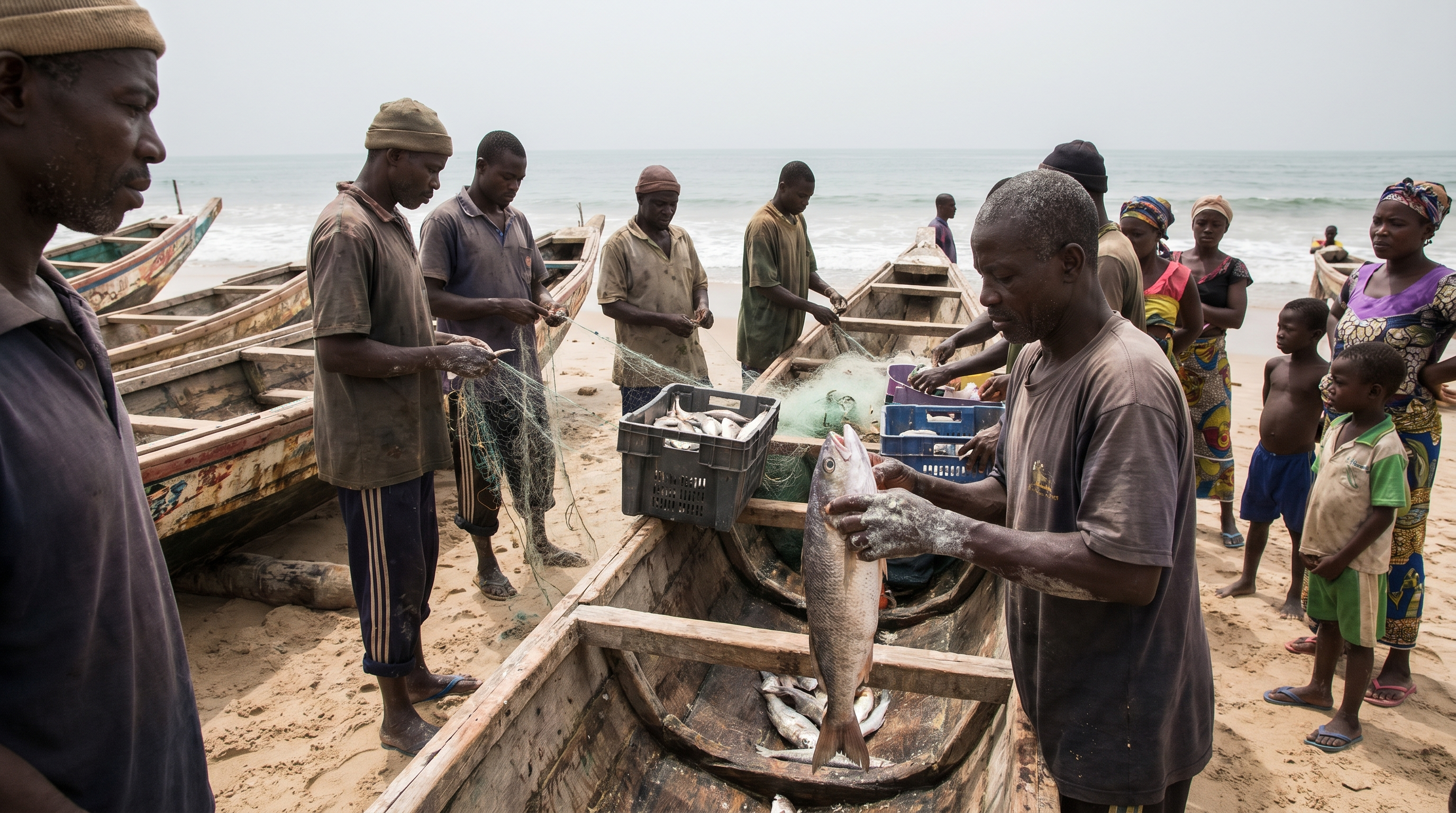
Coastal communities in West Africa – artisanal fishermen in Senegal, Mauritania, and neighboring countries have seen fish stocks drop sharply over 15 years. Local fishers describe having "no hope left" as industrial trawlers strip waters that sustain millions of livelihoods and provide primary protein for coastal populations. Senegal's fisheries alone support 1.3 million people directly.
Global seafood markets and food security – IUU fishing distorts fair trade, undercuts law-abiding fishers, and removes roughly one-fifth of global catch from transparent supply chains. Developing coastal states and small island nations dependent on fisheries bear the heaviest burdens.
Worsening in West Africa; stable to improving in monitored zones.
West African waters continue to deteriorate. Chinese trawlers operate largely with transmitters switched off, appearing only as "walls of lights" on satellite imagery – a tactic Peruvian fishermen coined "El Gran Muro de Luz." Despite a March 2026 fisheries cooperation agreement between Senegal and Spain focused on enforcement and traceability, illegal fishing pressure remains intense. Senegal rejected 52 Chinese-origin vessels seeking licenses, but reflagged operations persist.
Enforcement is intensifying in the North Pacific and Southeast Asian waters. Canada's fourth consecutive annual high-seas patrol demonstrates sustained commitment. Malaysia's Operation Naga shows measurable escalation: arrests increased 54% from August 2021 to March 2026, and seizure values nearly doubled in 15 months (RM141.8 million by December 2024 to RM244 million by March 2026).
The Port State Measures Agreement (PSMA) – the only legally binding international IUU fishing treaty – reached its 10-year anniversary on June 5, 2026. The treaty now has broad adoption and has successfully blocked IUU catches from reaching port markets in compliant states. However, enforcement gaps remain in non-party states and flag-of-convenience jurisdictions.
China's fleet continues to expand its global reach despite growing international scrutiny. The fleet serves dual purposes: securing food supplies for China while advancing "Great Maritime Power" ambitions through grey-zone operations and influence-building in the Global South. This strategic dimension makes purely economic enforcement insufficient.
Canada's Department of Fisheries and Oceans (DFO) deployed the CCGS Sir Wilfrid Laurier with 19 fishery officers for a two-month North Pacific patrol launched June 9, 2026. The operation includes U.S. Coast Guard, NOAA, and Royal Canadian Mounted Police participation, plus a Canadian officer serving as ship rider on a Japanese patrol vessel.
Malaysia's Maritime Enforcement Agency (MMEA) continues Operation Naga with sustained high-intensity enforcement: 639 arrests, 628 vessel seizures, and 5,329 crew arrests from 2019 through March 2026, with seizures exceeding RM244 million.
Senegal's Ministry of Fisheries rejected 52 Chinese-origin vessels seeking fishing licenses and signed a March 2026 fisheries cooperation agreement with Spain focused on sustainability, traceability, and IUU enforcement. However, the country lacks adequate patrol capacity to secure its exclusive economic zone against industrial-scale illegal fishing.
The Pew Charitable Trusts marked the 10th anniversary of the PSMA on June 5, 2026, highlighting port state measures as the primary international mechanism locking IUU catches out of legal markets. Pew continues advocating for broader PSMA adoption and stronger information-sharing among port states.
The International Seafood Sustainability Foundation (ISSF) published a June 2, 2026 analysis correcting inflated IUU fishing estimates in the Western and Central Pacific, emphasizing the importance of accurate data for effective enforcement and sustainable management. ISSF is pressing for rigorous vessel monitoring and transshipment oversight.
The OSW Centre for Eastern Studies released a May 27, 2026 report documenting China's distant-water fleet as a state-organized, state-subsidized "armada" serving national security and food security objectives beyond pure commercial fishing, calling for policy responses that address the fleet's strategic military and political dimensions.
 Photo : dvidshub.net / Wikimedia Commons — Public domain
INDEX: threat=IUU fishing | zone=North Pacific & West Africa | severity=serious | trend=worsening